As the seasons turned and the Being with Pigments solstice-to-solstice project came to a close, I marked the ending with a final assignment. It became a punctuation mark — a gathering of the thoughts and feelings that had surfaced, sometimes violently, sometimes in a soft whisper, during months of inquiry. As always, I sought connection and meaning. They arrived in fragments, in conversations with fellow artists, and in the solitude of my own making.
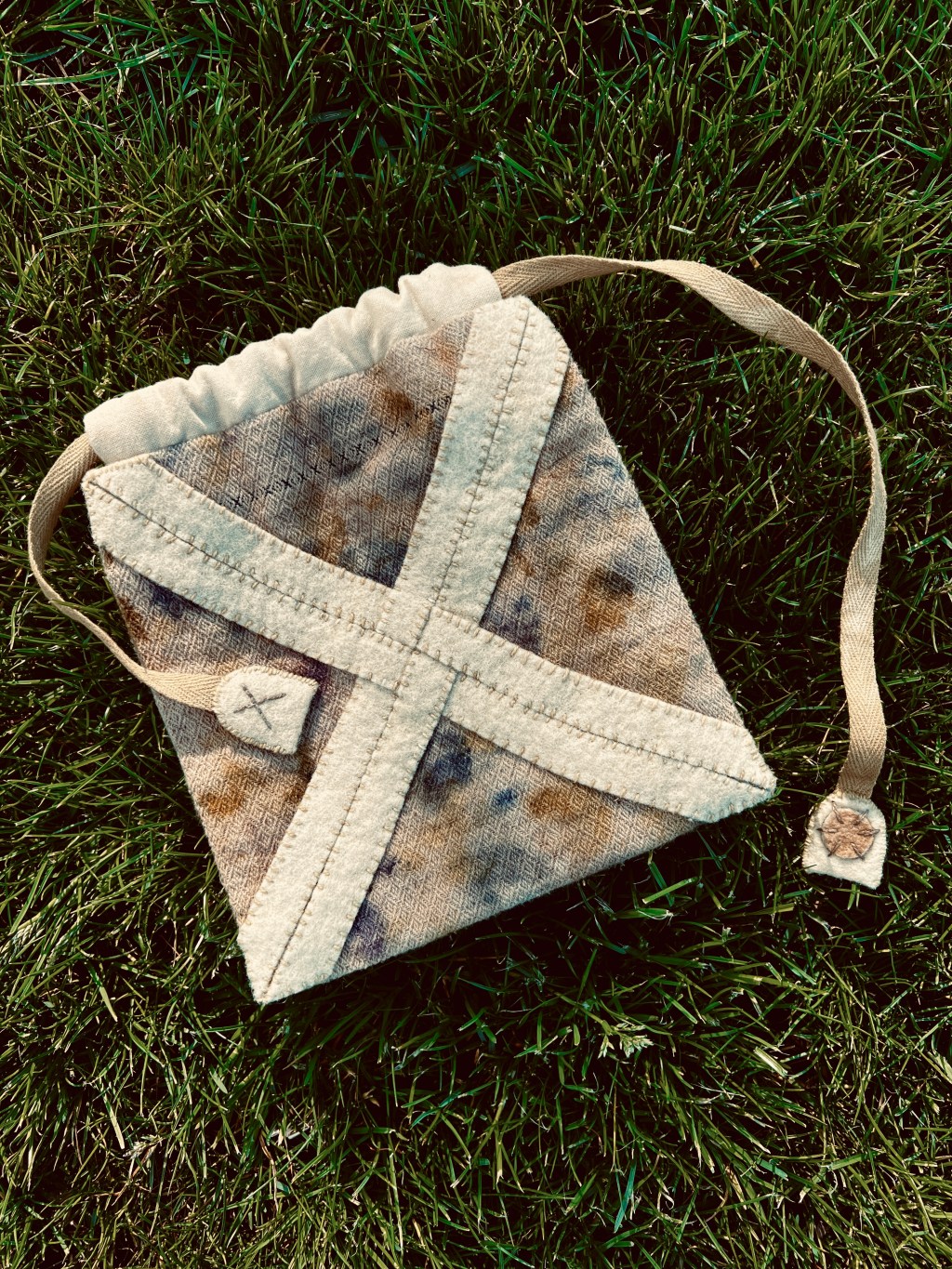
The work that emerged is a foraging pouch. Like much of what I create, it carries layered symbolism and multiple uses. It is, at once, a practical tool and a symbolic vessel. In its outer pocket, it gathers what the land offers — stones, feathers, shells, seeds — the visible, ecological language of the North. In its inner pocket, it holds what is less tangible but no less vital: impressions, memories, emotions, fleeting words, silences. This is the ecology and language of my soul. The six months spent researching, listening, learning, experimenting, practicing, focusing – the whole experience felt like a grand foraging expedition, in the most literal and metaphorical sense. I am prepared to move forward, to carry on with my foraging – with my pouch as my companion. Sometimes I walk along a path and pick up a physical object that catches my attention. Sometimes I carry my pouch with me just as a vessel to catch fleeting thoughts. In the capturing and treasuring of these thoughts, sometimes these very thoughts later become the focus of new work. The cyclical nature of this process is highly satisfying and gratifying.
This dual function also reflects how I want to approach literature and multilingualism in general: not only as written or spoken language, but also as something sensed, embodied, and carried. To write on handmade paper with handmade ink is itself a form of foraging — pulling language from the land, or from within myself. To stitch together those writings and marks with physical finds is to compose a dialogue between the human and the natural world, a dialogue that is multilingual in the widest sense.
Through this practice, I want to make works that hold both matter and memory, tangible and intangible, which ask: What counts as language? What kinds of language require reciprocity? What kinds of language are best suited for expression, and what kinds of language are suited for communication? Can we look beyond the regional languages we employ to communicate with one another to find and express our inherent multilingualism?
When I listen back to the audio recording I made for our final gathering, I still hear the moment alive in my voice. It was first made only for my collaborators, but I return to it often. Sharing it here, I hope it offers you something too.
Peripheral thoughts / On grieving Marigold
I’ve been thinking lately about Tilke’s invocation questions, and decided I’d like to read you something I’ve adapted from, of all things, a social media post I wrote four years ago. It feels like a good fit for this moment, and ties in well with my final assignment. We are at a transition point, in the season, in our relationships with each other and in our group, and, too, with pigments. These six months have been revelatory for me, and I have grown and transformed in myriad ways. I thank you all for being with me while I come into being with pigments.
On Grieving my Marigold
Six summers ago, I suffered a devastating, excruciating personal loss. As I worked through it, six years ago, I invited a few trusted friends and acquaintances to gather with me on the autumn equinox to ceremoniously honor my grief, accept the support of others, and observe the changing of the seasons. I set an intention not to try to move past my grief, but to weave its unruly strands into the fiber of my being and take one step, then another, forward. Sometimes I had to take a little rest, and I still do from time to time, but I continue to move forward. Shuffle, skip, shuffle, skip.
Grief made visible to me a spectrum of colors I previously had not known.
And I wore my grief like a blanket for as long as I needed it. And slowly, over time, I began to let it fall away. But it’s always there for me when I need it. And sometimes I need it. Sometimes I want to put it on again, or just tuck my toes under it. Sometimes it serves me by revealing how far I’ve come. I’m healing but parts of me stay raw, vulnerable. I’m altered. It makes me think of bigger, profound things, about life and humanity. About nature, and how all living things grieve the losses that just keep coming one after the other. I’m resilient. We are resilient. It is in our nature, and nature is resilient.
The day before I wrote this, I heard Terry Tempest Williams read from an essay she wrote called A Burning Testament; a response to the devastating wildfires of the west in 2020. It’s so beautiful and moving. She also spoke of the fireweed and its amazing adaptation to seed and flourish literally in the face of fire. She read: “I will mark my heart with an “X” made of ash that says, the power to restore life resides here.”
I echo those words now on the eve of the new season and reset my intention to seek balance and forward movement.
Also, I encourage you to read the entire essay.
As we step into this new season, I wish you the fortitude to persevere through difficulty and to raise your awareness to all that is whole and good and healing.
And to remember that even in grief, there is love. And that’s everything.
 Jenn Jansen